Google smart glasses privacy rules add tamper-proof LEDs
Google smart glasses privacy rules officially rolled out on November 12 as Google detailed the safeguards built into its new intelligent eyewear platform. The core upgrade centers on hardware-enforced capture alerts alongside automatic bystander face redaction before Gemini AI processes visual data. Purpose-built for early adopters seeking hands-free AI assistance without alienating those around them, the platform still faces an unavoidable reality: Google's policies cannot stop users from buying physical lens stickers from third-party marketplaces or sideloading unvetted tools on competing mobile platforms.
A decade after connected eyewear first hit the mainstream, the social landscape has shifted dramatically. With short-form video dominate platforms like TikTok and Instagram Reels, public sensitivity toward discreet recording devices has reached an all-time high. Recent pushback against competing camera glasses, often labeled by critics as invasive, demonstrated how bystander discomfort can quickly discourage owners from wearing their hardware in public. Seeking to sidestep that backlash, Google has outlined a privacy framework that spans physical device hardware, cloud processing, and service-level platform policies.

Onboard Privacy: Hardware Sensors, Face Redaction, and Gemini AI
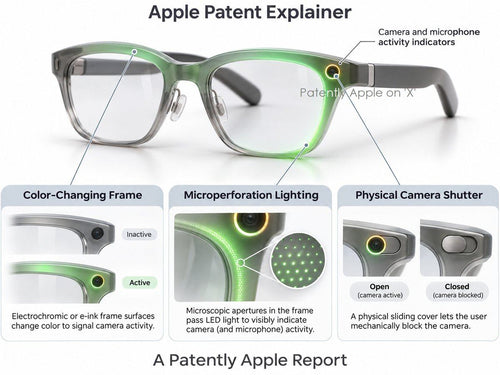
At the physical level, Google's eyewear incorporates an external LED indicator on the left side of the frame, opposite the camera module beside the right eye. Unlike earlier generations of smart glasses where users could easily obscure status lights with tape or marker ink, these frames feature dedicated sensors to detect if the LED is covered or tampered with. If tampering is detected, the device actively blocks photo and video capture. While XR lead Juston Payne acknowledged that bad actors will continuously probe for workarounds, the automated cutoff establishes a critical hardware baseline. The frames also include a physical power switch with an explicit red indicator confirming complete shutdown.
Privacy handling around Google's Gemini AI is equally specific. When the assistant uses the camera stream to contextualize what the wearer is looking at, the incoming visuals are not saved to the user's Gemini history. Before the model processes the scene, the software automatically redacts bystander faces. Furthermore, Google confirmed that camera streams are excluded from AI model training and advertising targeting, with off-device transmission protected by encryption and routed through its Private AI Compute sealed cloud architecture.
Audio capture follows a similar isolation strategy. The glasses use a four-microphone array equipped with beamforming algorithms. For live translation features, the microphones focus directly on the individual the wearer is facing. For voice queries, the directional pickup isolates the user's speech while filtering out ambient background conversations, preventing accidental recordings of nearby strangers while keeping Gemini from confusing background chatter with an active voice prompt.

Ecosystem Controls: Play Store Rules, YouTube Policies, and Advertising Bans
Beyond device-level safeguards, Google is leveraging its broader service footprint to curb misuse. Google Shopping and Google Ads now prohibit the sale and promotion of accessories or stickers designed to conceal recording indicators. On content distribution networks, YouTube enforces blanket removal policies against harassment and non-consensual recordings regardless of whether footage originated from a smartphone or smart eyewear.
Third-party application integration also faces strict boundaries. Access to the camera requires granular operating system permissions that users can grant or revoke per app. Google Play Store developer and API policies explicitly ban apps from utilizing the camera for real-time facial recognition, public social live-streaming, or altering the behavior of the exterior LED indicator. Hardware activation additionally requires an authenticated Google account verifying the user is at least 18 years old.
Nevertheless, Google's unilateral ecosystem restrictions highlight the broader industry challenge. Because the glasses maintain compatibility with iOS, Google cannot police software distribution across external app stores, nor can it stop unvetted LED-blocking accessories from proliferating on global retail sites like Amazon or Temu. Establishing lasting public trust in smart eyewear will ultimately depend on whether rival hardware makers adopt matching standards across the entire wearable ecosystem.
Do automatic face redaction and tamper-resistant LEDs address your privacy concerns when seeing smart glasses in public, or do hardware cameras on faces still cross a line? If you are considering smart glasses, which feature matters more to you: on-device privacy controls or tighter cross-platform app bans?

Leave a comment