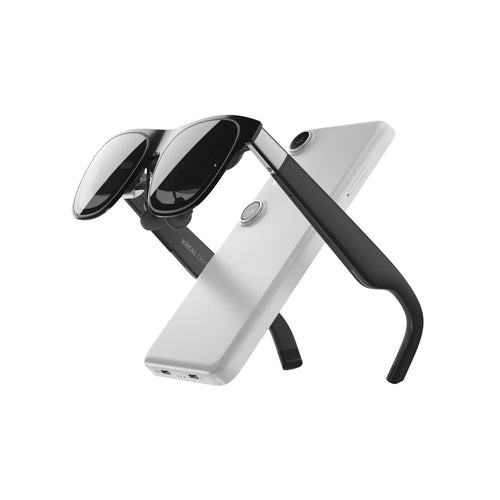
Rayneo GT Max Review: A 267-Inch Private Cinema You Can Take Anywhere
The allure of a movie theater isn't just about the larger screen; it's the immersive experience when the lights dim, focusing all your attention on the picture and sound. Many have tried to replicate this at home, but a true home theater is more than just one device. For young people in cities, limited living space, the hassle of moving large TVs, and the complexities of projectors often make a personal big-screen setup an elusive dream. The Rayneo GT series offers a direct solution: instead of adapting your room for a screen, it puts a giant screen inside a pair of glasses.

With the Rayneo GT, you no longer need a dedicated wall or a specific living room layout. Once you put them on, your viewing experience is defined by the device itself, not the size of your home. Priced accessibly, it feels more like a personal electronic gadget than an elaborate home entertainment system. It effectively removes the primary prerequisite for a giant-screen experience: a suitable space.
The most immediate and striking change upon wearing the GT Max is the expansive field of view (FOV). If you've used previous models, the 59° FOV of the GT Max feels significantly more open, transforming the experience from a "TV on your head" to a genuine private IMAX theater in your glasses. This larger view greatly alleviates any sense of confinement at the edges of the screen.
Marking a world first, Rayneo has integrated Dolby Vision into these lightweight AR glasses. When connected to the Rayneo Magic Box 2, the visual quality is undeniable. Watching a Dolby-native film like *Avatar: The Way of Water*, the deep blacks of the ocean are pure, while the glowing spots on the Na'vi's skin and luminescent creatures create a stunning contrast without any overexposure or washout. Details like the Tyndall effect from sunlight piercing the water are rendered with perfect clarity.

Beyond picture quality, the glasses feature thoughtful interactive design. A physical button on the right temple allows you to switch between three 3DoF spatial modes: Fixed, Follow, and Anti-shake. The Anti-shake mode is particularly impressive. It keeps the screen stable like a physical monitor during small movements but smoothly follows your gaze when you shift your position more significantly, such as from sitting to lying down. This intelligent adjustment prevents the motion sickness often associated with traditional "follow" modes, feeling akin to optical image stabilization on a camera lens.
To complement the stellar visuals, Rayneo collaborated with B&O on a four-speaker spatial audio system with head-tracking, and the results are surprisingly good. The sound is immersive and enveloping. During the underwater scenes in *Avatar*, you can clearly hear the currents overhead and the subtle rustle of fish swimming past. The low frequencies have a solid presence, and dialogue remains crisp. Furthermore, the open-ear design is comfortable for long sessions, and its sound leakage control is effective enough for use in shared spaces without disturbing others.
The Rayneo GT Max's premium experience is powered by its companion, the new Magic Box 2. Resembling a compact power bank, it's lightweight and features a premium aluminum body with a large AG glass touchpad. It's designed for blind operation with gesture controls and a gravity-sensing cursor. It includes a TF card slot for personal media, two Type-C ports for simultaneous charging and connection, and a 4000 mAh battery that can last for two full movies. The glasses can also be used without the box by connecting directly to a Mac or Nintendo Switch, instantly becoming a high-quality, large-screen portable display.
Despite packing in so much technology, the Rayneo GT Max weighs only 78g, making it comfortable for extended wear. However, there are a few limitations. The Dolby Vision feature is currently tied to the Magic Box 2 and specific streaming app memberships. Due to the BirdBath optics, slight chromatic aberration is visible on high-contrast edges. The initial QR code login process can be a bit clumsy, and the device is still dependent on a physical Type-C cable, which slightly limits absolute freedom of movement.
While it won't entirely replace the ceremonial experience of a movie theater, it provides an excellent alternative for countless everyday scenarios. It proves that a massive, immersive screen experience can happen even in the smallest of spaces, and for many, that's more than enough.